We’ll answer your most burning questions about marble in this guide so you can determine if marble is the right choice for your home.
Marble stone is found primarily in quarries in Italy, China, India, and Spain. Other countries also have some marble, including the United States.
Marble is a natural stone in the metamorphic rock family.
Limestone sometimes undergoes extreme heat and pressure near igneous granite, generally along tectonic plate boundaries around the world. The rock is transformed by the recrystallization of certain minerals in the rock. In addition, the original carbonate minerals change into calcite. This results in a beautiful “interlocking carbonate crystal mosaic.”
The different varieties of marble come from different minerals that are present during the process, changing the marble’s pattern and color.
Marble slabs or marble tile can be used for the following applications:
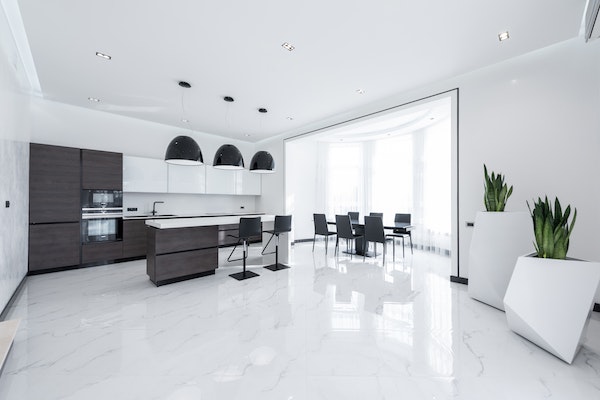
Marble is exquisitely beautiful. But there are some important questions to ask before deciding to use marble in your bathroom or kitchen.
Yes, marble is porous. This means it can absorb water and other liquids into tiny holes in its surface.
Because marble is porous, marble countertops, backsplashes, floors, or showers will need an application of marble sealer every year or every few months to keep damaging liquids out of the stone. If you put a few drops of water on your marble and they sink in, your marble is not sealed well enough. Liquids should bead on top, otherwise you may experience staining.
Marble is quite durable but it can scratch because it is softer than granite and other stones. You don’t want to use knives on it. Your counter could scratch and the stone can dull your knife’s edge.
Even banging a heavy pot against the edge of a marble countertop in the kitchen could cause chipping or scratching.
This is why people tend to prefer marble for bathrooms, offices, or fireplace surrounds where they won’t get as much wear and tear.
Marble is heat-resistant. So it is not as prone to damage from hot pots as some countertop surfaces. However, you still need to use a trivet or potholder because a very hot pot could burn the surface of any natural stone, leaving it discolored.
Yes, particularly if marble is not sealed, it can easily absorb liquids and it can be almost impossible to clean the stains. This is a disadvantage of marble countertops in the kitchen where wine, mustard, tomato juice, and other liquids could be an issue if you don’t keep up with sealing the marble on time.
Marble kitchen countertops are very durable in some ways, but they have some weaknesses:
This is why marble may be better suited to bathrooms or areas other than kitchens for some homeowners.
Both marble and granite are natural stones with incredible beauty and durability that add a lot of value to your home. Both are rather pricey and require sealing to protect from staining from water or other liquids.
Marble is a metamorphic/sedimentary rock with veining of minerals. It comes primarily in white or black, although other variations are available. Marble is porous and can be stained by liquids or etched from contact with acids.
Granite is a metamorphic/igneous natural rock. It is granular and has a wide variety of colors and patterns including flecks, veins, and solids. Granite is harder than marble and less likely to scratch or chip. Granite is generally less expensive than marble and lower maintenance.
Cultured marble is an engineered (man-made) stone that consists of powdered marble dust, pigments, and resins. Cultured marble can be molded in a cast and can have realistic patterns that mimic natural marble.
Cultured marble is less expensive than natural marble. It is non-porous and low maintenance (doesn’t require sealing). Its durability, stain resistance, chip resistance, and mildew resistance make it very popular.
However, cultivated marble is just not as gorgeous as the natural stone and doesn’t have the same type of veining.
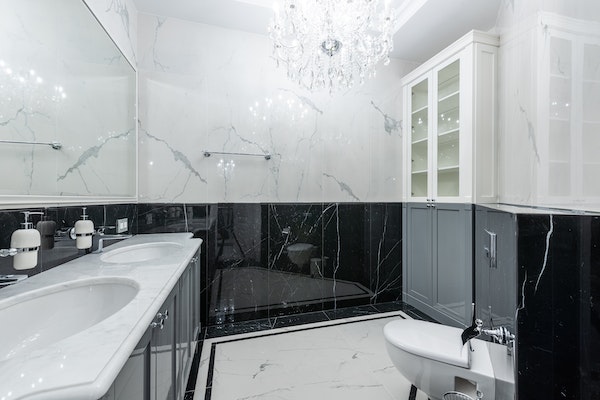
Black marble – from England, a fine-grained sedimentary rock that is not true marble, geologically.
White marble – naturally water-resistant
At Blythe Building Company, we build luxury homes in the greater Columbia, SC area. Generally starting at about $650,000, we bring people’s dream homes to life.
We can help you use marble in your home whether it is in slab or tile form for countertops, walls, floors, showers, and more.
Which Is Better? Quartz VS Quartzite for Kitchen Countertops? (great for bathrooms, too!)
Our Top 13 Luxury Features for Custom Homes
What Is a Scullery and Why Do You Need One?
What Is the Best Flooring for Dogs?
How to Clean Marble by Better Homes and Gardens
How to Seal Marble Countertops by Marble.com